
Architecture
lxask is one Rust program and four files: the model, its restriction adapter, a small encoder and a SQLite index of documentation. Everything runs on your machine, on the CPU. Python is used only to build those files and to measure the result, and it calls the same Rust core the program uses, so what is measured is what ships.
For the reasoning behind each step in prose, see How it works; for numbers, Results.
#Answering a request
What happens between lxask "..." and the printed command
(rust/crates/lxask/src/main.rs, rust/crates/lxask-core/src/answer.rs):


Two shortcuts answer without the model at all: questions about lxask itself, and requests too vague for one command ("add a proxy"). Everything else goes through the model, one call per task plus one for the split, and up to two more per task when the checks object.
#Components


| crate | what it is |
|---|---|
lxask |
the program: options, the server, feedback, settings |
lxask-core |
every rule, with no I/O: the model and the search are passed in, so it is tested without them |
lxask-llm |
the model, the adapter and the encoder, through llama.cpp |
lxask-py |
the core as the Python module lxask._core, used by src/lxask and scripts/ |
#The server
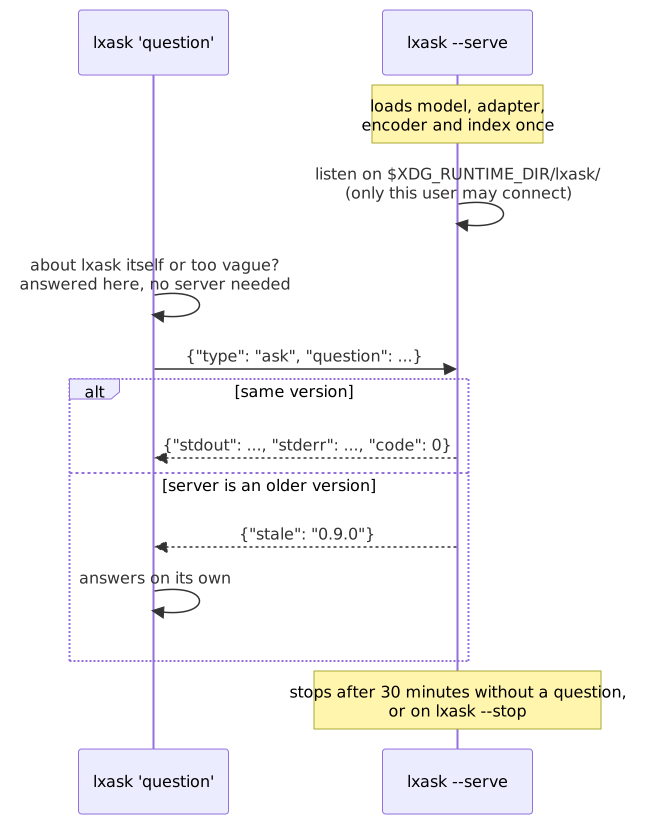
lxask --serve keeps everything loaded, so later questions skip the few seconds of
loading. With serve = auto (the installer's default) a question that finds no
server starts one in the background, detached from the terminal, and waits for it;
a lock next to the socket makes sure only one is started (server::start_and_wait).
#Feedback


#How the model and the index are made
Offline, on a machine with a GPU (a free Colab T4 or a laptop RTX card):


The evaluation sets are kept out of training throughout; the execution tests run each command as an unprivileged user in a container with no network (Development).
#Files on disk
Everything lives in ~/.local/share/lxask: the model, the adapter, the encoder, the
index, last.json and your feedback.jsonl; the program is ~/.local/bin/lxask.
The full list and every setting: Configuration.
#Design choices
- Check, don't trust. A 1.5B model gets details wrong, so every command is
checked against the documentation and the request, retried when a check objects,
and marked
unverified:when it still fails. It never runs a command. - Small, local, offline. One program and about 1.1 GB of files, 1.3 GB of memory while answering, no network after installing.
- Route instead of retrain. The model fine-tuned on restrictions got worse on everyday questions, so it ships as an adapter used only for the requests it is better at (Results).
- Ask back instead of guessing when a request means different commands in different contexts.
- Fixed text for questions about lxask, rather than teaching the model facts about itself.
- One core for the program and the measurements. Training and evaluation call
the same Rust code through
lxask._core.